EPF Withdrawal for Illness 2026: Rules, Limits & Process
When someone in the family falls seriously ill, the first question people ask is almost always the same: “Can I take money from my PF, and how fast?” Hospital bills don’t wait, and most working professionals in India have far more money locked in their Provident Fund than sitting in a liquid savings account.
Under the Employees’ Provident Funds Scheme, 2026, Once you have completed 12 months of total PF membership, you can withdraw up to 100% of your Eligible Member Balance for the treatment of yourself or a family member. Even better, there is no cap on how many times you can apply. The only core condition is that 25% of your total PF contributions must stay in your account to safeguard your retirement.
What the EPF Scheme 2026 Says About Medical Withdrawals
The Employees’ Provident Funds Scheme, 2026 was notified under the Code on Social Security, 2020, replacing the decades-old 1952 Scheme.
Under Paragraph 46(2)(a) (“Partial withdrawals from Fund”), the medical advance rules state:
- Who is covered: Treatment for yourself or your dependent family members.
- Maximum amount: Up to 100% of your Eligible Member Balance (including both employee and employer shares).
- Minimum membership: You must have completed 12 months of total membership in the Fund.
- Minimum withdrawal: Each request must be for at least ₹1,000 (under Para 46(1)).
- No frequency limits: Unlike education (capped at 10 times) or marriage (capped at 5 times), illness withdrawals have no lifetime cap. This is critical for long-term treatments like chemotherapy or dialysis that require staggered payments.
Old Rule vs. New Rule: Key Differences
If you previously took a medical advance under the old 1952 Scheme, the new framework operates quite differently:
| Parameter | New Rule (2026 Scheme, Para 46) |
| Maximum Amount | Up to 100% of Eligible Member Balance (Employee + Employer share) |
| Minimum Membership | 12 months total membership |
| Mandatory Retention | 25% of total contributions + interest must remain locked |
| Frequency Cap | No limit |
| Medical Certificate | No mandatory medical documents listed in Scheme |
The biggest gain is access to the employer’s share, significantly boosting your available emergency fund. The trade-off is the 12-month initial waiting period, which affects workers in their very first year of employment.
Who Can Claim & Whose Illness Is Covered?
You are eligible if you have an active Universal Account Number (UAN) and at least 12 months of total PF membership.
Under Paragraph 47, “total membership” includes:
- Your continuous service across all previous employers
- Membership in a private exempted PF trust before joining an EPFO-covered firm.
- Service with an establishment prior to it coming under the EPF Act.
If you switched jobs 3 months ago but worked for 2 years previously, you are fully eligible—as long as you transferred your old PF account.
Covered Family Members
“Family” follows the definition under the Code on Social Security, 2020, covering your spouse, children, and dependent parents. There is no restricted list of medical conditions; any genuine treatment (hospitalization, surgeries, or long-term therapeutic care) qualifies.
Incapacity to Work: Partial withdrawal is for active employees undergoing treatment. If an illness permanently prevents you from working, Paragraph 49(1)(ii) allows a full final PF settlement upon submission of a medical certificate from a registered medical practitioner. Conditions like cancer, tuberculosis, or leprosy are automatically treated as total permanent incapacitation for settlement purposes.
How Much Can You Withdraw? (The 25% Rule Explained)
Understanding your exact limit comes down to two calculations:
- Minimum Balance (25%): Exactly 25% of all total contributions made to your account (employee + employer share) plus accumulated interest. This money must stay locked in your account.
- Eligible Member Balance: The remaining 75% of your corpus, which is the absolute maximum you can withdraw.
Calculation Example
If your total passbook balance (contributions + interest) is ₹6,00,000:
- Total PF Corpus: ₹6,00,000
- Minimum Locked Balance (25%): ₹1,50,000
- Eligible Member Balance (75% Max Withdrawal): ₹4,50,000
You don’t need to request the full ₹4,50,000. Only ask for what you currently need. The remaining funds continue to earn tax-free EPF interest.
Note on Pension (EPS): Your Pension Fund contributions are held separately under EPS rules and cannot be drawn as a medical advance. The withdrawal calculation applies strictly to your PF account balance.
Required KYC & Documents
Under the streamlined 2026 rules, most medical advance claims are auto-settled without manual document uploads. What you must have in place is clean, verified KYC:
- Activated UAN linked to an active mobile number registered with Aadhaar (for OTP verification).
- Aadhaar Seeded & Verified in the EPFO database.
- Bank Account Linked & Approved: Correct IFSC code verified by your current employer.
- PAN Linked: Prevents tax holds or administrative flags.
- Matching Demographic Details: Name, Date of Birth, and Gender must be identical across Aadhaar, bank records, and EPFO files.
Step-by-Step: Applying Online via UAN Portal
Filing a medical claim takes less than 10 minutes if your KYC is completely approved:
- Log in to the EPFO Member Portal (
unifiedportal-mem.epfindia.gov.in) using your UAN and Password. - Verify your status under Manage > KYC.
- Go to Online Services > Claim (Form-31, 19, 10C & 10D).
- Verify your bank account by entering the last 4 digits of your registered bank account.
- Select Form 31 (PF Advance) and choose Illness as the purpose of withdrawal.
- Enter the required withdrawal amount (do not exceed your Eligible Member Balance).
- Enter your residential address, tick the declaration box, and click Get Aadhaar OTP.
- Enter the OTP received on your Aadhaar-linked mobile to submit the claim.
Alternatively, you can submit the exact same claim through the UMANG App under EPFO > Raise Claim using Face Authentication or Aadhaar OTP.
Timelines, Tracking, & Tax Rules
- Settlement Time: Under Paragraph 54(7), complete claims must be processed within 20 days. In reality, clean KYC claims submitted under the illness category are processed via auto-settlement within 3 to 5 working days.
- Penal Interest: If EPFO delays an eligible, error-free claim past 20 days without valid cause, Paragraph 54(9) mandates a 12% annual penal interest paid to the member.
- Tracking: Check your claim progress under Online Services > Track Claim Status on the Member Portal or UMANG App.
- Taxation: Partial withdrawals taken as a medical advance are non-taxable and do not attract TDS deductions.
Common Rejection Reasons & How to Avoid Them
| Rejection Reason | What It Means | How to Fix It |
| Bank Name Mismatch | Your name on the bank account doesn’t match EPFO records letter-for-letter. | Update your bank account details on the portal and get employer re-approval. |
| Illegible Cheque/Passbook | Image uploaded (if requested) was blurry, missing the name, or lacking the IFSC code. | Upload a crystal-clear PDF or JPEG showing your printed name, account number, and IFSC. |
| Exceeds Eligible Balance | You requested more than the 75% limit or recent uncredited contributions caused a calculation error. | Check your live passbook balance and re-apply for a slightly lower figure. |
| Under 12 Months Service | Previous employer accounts were never transferred, showing insufficient service history. | File a transfer claim (Form 13) for old accounts before filing the advance. |
| Pending Claim Exists | Another claim is actively being processed by the system. | Wait for the previous claim to finalize before filing a new one. |
Frequently Asked Questions (FAQs)
1. How much EPF balance can I withdraw for illness in 2026?
You can withdraw up to 100% of your Eligible Member Balance (which is your total corpus minus the mandatory 25% minimum balance).
2. What is the minimum service requirement for a medical advance?
You need a total of 12 months of PF membership. Previous jobs count toward this total if you transferred your accounts.
3. Can I claim a PF advance for my parents’ medical bills?
Yes, provided your parents are dependent family members under social security definitions.
4. Do I need to upload hospital bills or a doctor’s certificate?
Under the 2026 Scheme, documentation is generally not required for partial illness claims, enabling fast online auto-settlement.
5. Is the old “6 months’ basic wages” limit still active?
No. That cap belonged to Paragraph 68J of the repealed 1952 Scheme and was officially replaced on 29 June 2026.
Actual Process for EPF Emergency Withdrawal on Portal
This process is very similar to the general EPF Withdrawal process with few changes in the category selection as well the amount which you can apply for (Only Employee share)
1.Login to the UAN Member Portal:Keep your UAN and password ready.
Go to the official EPFO Member Portal, enter your Universal Account Number (UAN), password, and CAPTCHA code, then click Sign In. Complete two-factor authentication (OTP) if prompted.
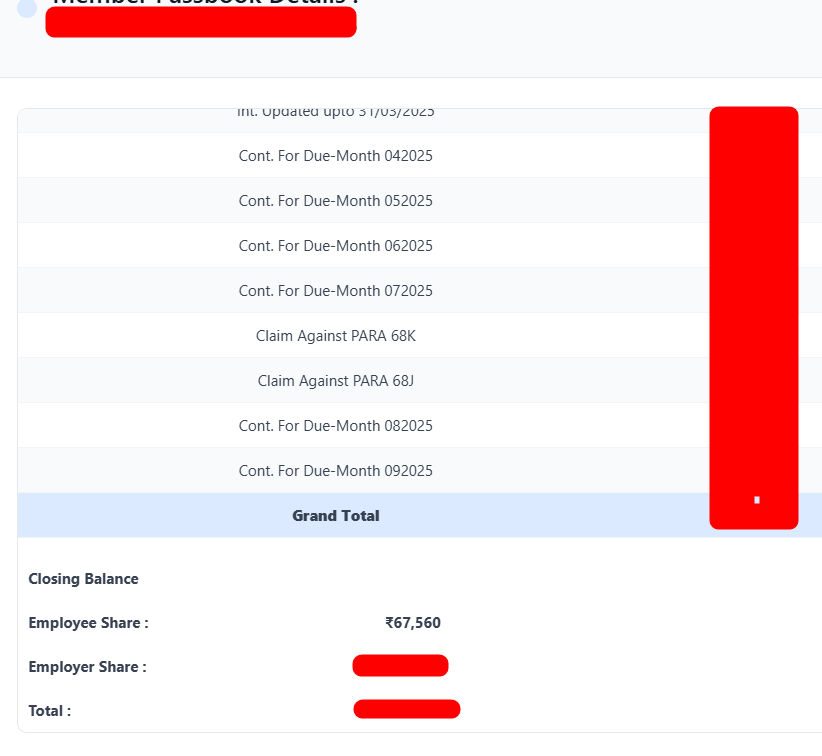
2.Check Your Eligible Employee Balance:Use Passbook Lite under the View menu.
Navigate to View in the top menu bar and select Passbook Lite. Select your active Member ID from the list. A pop-up window will display your yearly contribution breakdown. Scroll to the bottom to verify your current Employee Share corpus—this is the maximum amount you can request for an illness advance.
3.Open the Online Claim Section:Navigate to Online Services.
From the main navigation menu, click on Online Services and select Claim (Form-31, 19, 10C & 10D) from the drop-down menu.
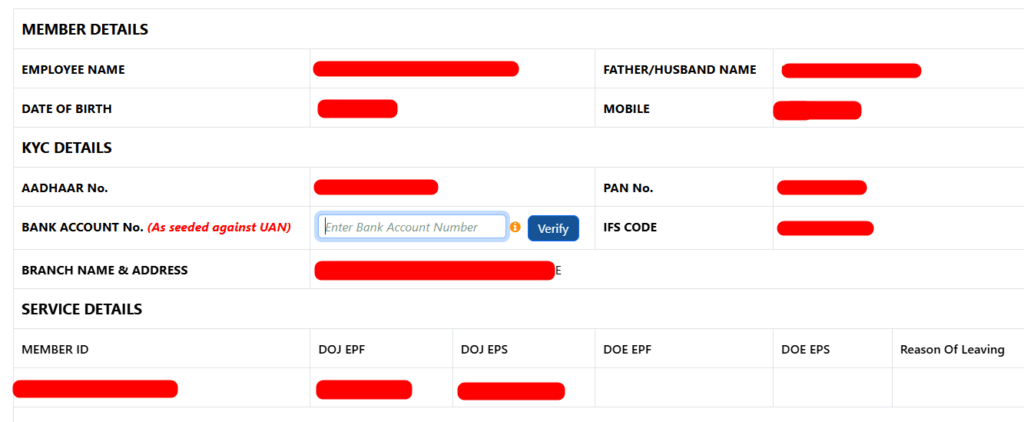
4.Verify Your Bank Account:Must match UAN-linked bank details.
On the claim page, enter the full Bank Account Number linked and approved under your UAN KYC. Click Verify, accept the terms and conditions in the pop-up modal, and click Proceed for Online Claim.
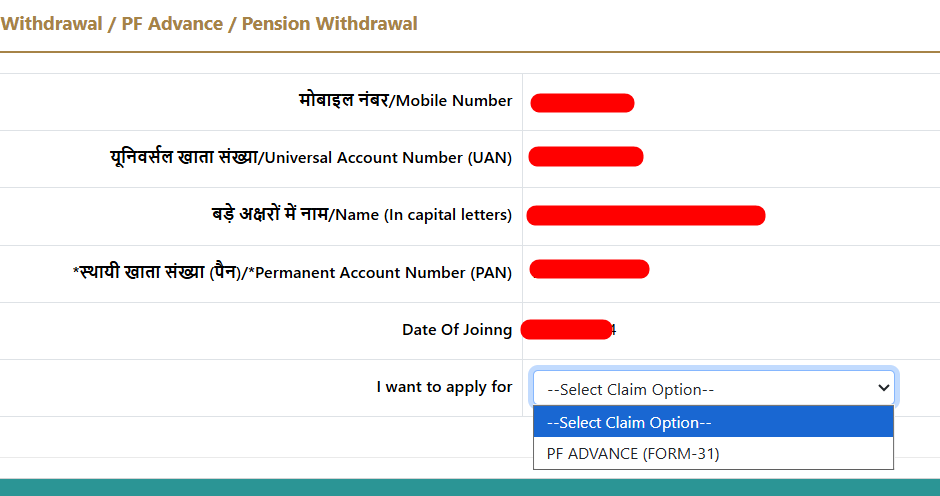
5.Select Advance Purpose and Employer:Choose Form 31 (PF Advance).
Under the I want to apply for option, select PF Advance (Form 31). Choose your current employer’s Member ID from the company list. Select Illness from the drop-down list of advance purposes, and enter your requested amount (ensuring it does not exceed your Employee Share balance).
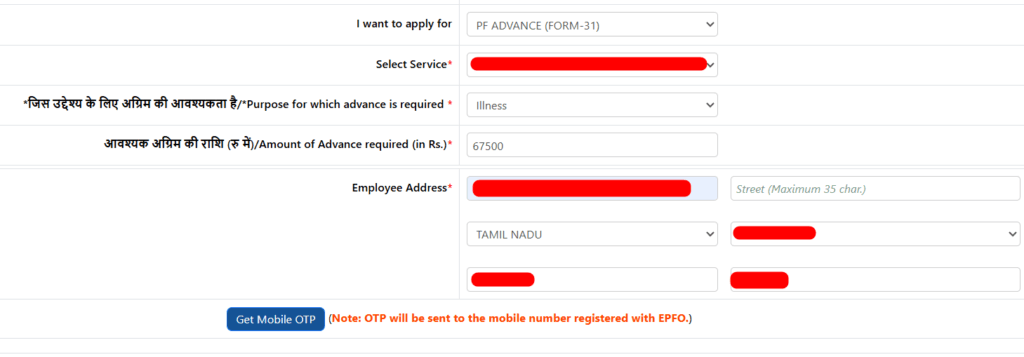
6.Authenticate via Aadhaar OTP:Finalize and submit your claim.
Enter your complete postal address. Upload a clear scanned image of your cancelled cheque or bank passbook (if requested), check the declaration box, and click Get Mobile OTP. Enter the OTP received on your Aadhaar-linked mobile number and click Validate OTP and Submit Claim.
Under Para 46(2)(a) of the EPF Scheme 2026, you can withdraw up to 100% of your Eligible Member Balance for the illness of yourself or your family, as often as needed, once you have 12 months of total membership. Keep 25% of your contributions in the account, apply online with an Aadhaar OTP, and expect settlement within 20 days, often much sooner.
The single best thing you can do is keep your KYC clean before you need the money. A medical emergency is the worst time to discover that your bank account was never approved.
For other reasons to withdraw, read our guides on partial withdrawal eligibility and full PF withdrawal rules.
Sources
- Employees’ Provident Funds Scheme, 2026, G.S.R. 525(E), Gazette of India (Extraordinary), 29 June 2026: Paras 46, 47, 48, 49 and 54
- The Tribune: EPFO allows 100% EPF part withdrawals, 13 rules merged into 3 categories (14 October 2025)
- EPFO Member portal

Sankara Narayanan is a retired Enforcement Officer from Provident Fund Organization Madurai., He has worked nearly 35+ years in Employees Provident Fund Organization and has extensive experience in PF Withdrawal Claims, PF Account Transfer and other areas related to EPF
https://www.linkedin.com/in/sankara-narayanan-4667385a/