Your Employees’ Provident Fund (EPF) is designed to be a long-term safety net, primarily meant to secure your retirement. Because of this, the rules surrounding withdrawing your entire EPF corpus are strict.However, life is unpredictable. Whether you are facing a medical emergency, moving abroad, or dealing with a sudden job loss, the statutory guidelines outline several specific scenarios where you are legally permitted to withdraw the full amount standing to your credit.
EPF Full Withdrawal Rules
- Retirement and Age-Based Withdrawals
- Medical Incapacity and Health Emergencies
- Career Changes, Retrenchment, and Relocation
- Standard Resignations (The 12-Month Rule)
- What Happens if You Rejoin the Workforce?
Based on the official regulatory framework, here is a complete, expert guide to exactly when and how you can make a 100% EPF withdrawal.
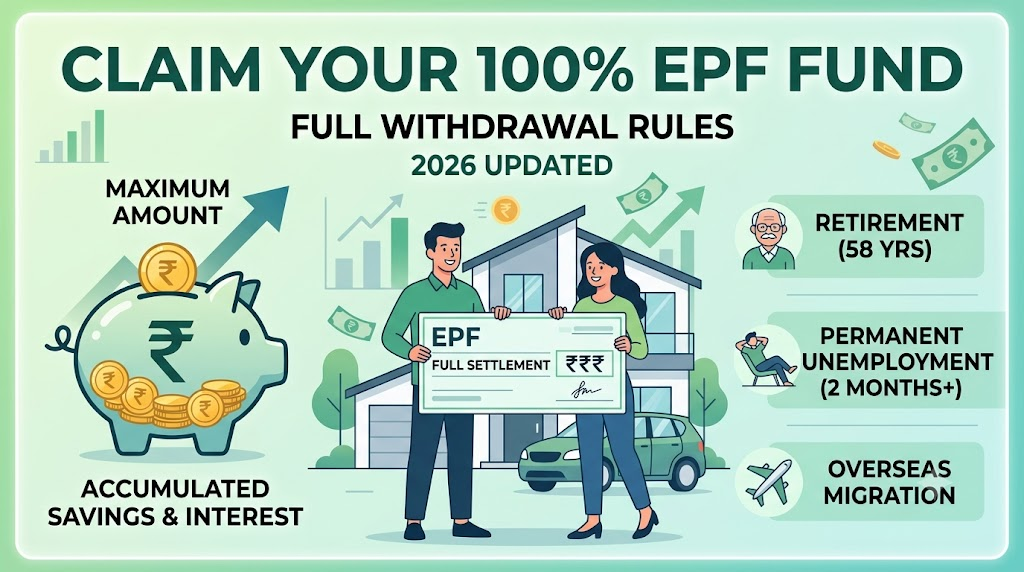
Retirement and Age-Based Withdrawals
The most straightforward way to access your entire PF balance is by reaching retirement age.
- Standard Retirement: You can withdraw 100% of your funds upon retiring from service after attaining the age of 55 years.
- Early Termination: If your service is terminated before you turn 55, you do not lose your money. You are fully entitled to withdraw the entire amount if you cross the 55-year threshold before the payment is officially authorized.
Medical Incapacity and Health Emergencies
If a severe bodily or mental infirmity renders you permanently and totally incapacitated for work, you are eligible for a full withdrawal. To claim this, you must provide a medical certificate. The rules for this certification are highly specific:
- Standard Procedure: The certificate must come from the establishment’s medical officer or a registered medical practitioner designated by your employer.
- ESIC Coverage: If your workplace falls under the Employees’ State Insurance (ESI) Scheme, the certificate must be issued by the ESI medical officer or your registered Insurance Medical Practitioner.
- Closed Establishments: If your company has permanently closed down, a certificate from any registered medical practitioner is acceptable.
- Special Illnesses: If you suffer from Tuberculosis (TB), Leprosy, or Cancer, you are automatically deemed permanently and totally incapacitated. This applies even if you contracted the illness after leaving your job but before the payment was authorized.
Important Note on Medical Scrutiny: The Regional Provident Fund Commissioner (RPFC) holds the right to demand a fresh medical evaluation from a Civil Surgeon if the original certificate seems suspicious.
- If the Civil Surgeon agrees with your original certificate, the EPF Fund pays the surgeon’s fee.
- If the findings contradict your original certificate, the Fund pays half the fee, and the remaining half is deducted directly from your PF account balance.
Career Changes, Retrenchment, and Relocation
You can fully withdraw your EPF balance under several employment-related contingencies:
- Going Abroad: You can withdraw your funds immediately before migrating from India for permanent settlement or to take up employment in a foreign country.
- Retrenchment & Voluntary Retirement: Full withdrawals are permitted in cases of mass or individual retrenchment, or if you terminate your service under a mutually agreed Voluntary Retirement Scheme (VRS).
- Transfers to Non-Covered Establishments: If your factory closes or you are transferred to an establishment that is not covered under the EPF Code (even if it’s under the same employer), you can withdraw your funds.
- Discharge with Compensation: If you are discharged and receive retrenchment compensation under the Code on Industrial Relations, 2020.
Note: For transfers to non-covered establishments or discharges with compensation, the actual payment will only be processed after a continuous waiting period of at least two months from your date of application.
Standard Resignations (The 12-Month Rule)
What if you simply quit your job and don’t fall into the categories above?
You can still withdraw your full EPF amount, but a strict waiting period applies. The Central Provident Fund Commissioner permits full withdrawals if you cease to be an employee in a covered establishment, provided you remain unemployed in any EPF-covered establishment for a continuous period of at least 12 months immediately preceding your withdrawal application.
The Marriage Exemption for Women: There is a specific exemption to this 12-month waiting period: Female members who resign from the services of their establishment specifically for the purpose of getting married are exempt from the waiting period and can withdraw their funds immediately.
What Happens if You Rejoin the Workforce?
If you successfully withdraw your full EPF amount under the standard resignation rule (the 12-month rule) but eventually decide to rejoin the workforce in an EPF-covered establishment, you will have to start fresh. You will be required to qualify again for EPF membership, and upon qualifying, you will be treated entirely as a new, fresh member of the Fund.
source:epfindia.gov.in